
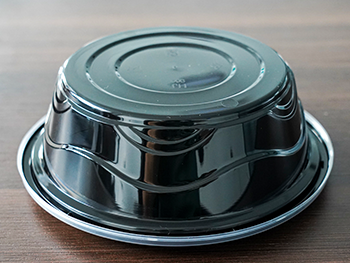
American Style 900 Black Thickened Disposable Plastic Round Container: A Complete Industry Guide
The American Style 900 Black Thickened Disposable Plastic Round Container is a food-grade packaging solution widely used in foodservice, takeout, catering, and retail food display. The designation “900” refers to its nominal capacity of 900 milliliters, a mid-sized volume that suits individual meal portions, side dishes, salads, pasta, rice bowls, and prepared foods. The term “American Style” describes a specific design profile characterized by a round base with a snap-fit or press-on lid, typically featuring a contrasting color scheme of a black base and a clear or translucent lid . This visual contrast serves both practical and aesthetic purposes: the black base masks staining and scratches during transport, while the clear lid allows visual inspection of contents without opening, which is valued in grab-and-go retail environments.
The “thickened” attribute distinguishes this container from standard thin-wall disposable food containers. Thickening refers to increased wall gauge and structural reinforcement, which improves rigidity, reduces deformation under load, and enhances resistance to cracking during stacking and handling . In the context of disposable food packaging, thickening is not merely a matter of material cost—it directly affects the container’s performance in microwave reheating, leak prevention, and consumer perception of quality.
The overwhelming majority of American Style 900 black thickened containers are manufactured from food-grade polypropylene (PP), a thermoplastic polymer recognized for its safety, heat resistance, and mechanical toughness . PP is naturally BPA-free and does not release harmful compounds under normal food contact conditions. Industry-standard products typically comply with FDA food contact regulations in the United States and LFGB standards in the European Union, though compliance documentation should always be verified with the specific supplier .
The material’s thermal tolerance is a critical performance attribute. Quality PP containers in this category are rated for use across a temperature range of approximately -20°C to 120°C, making them suitable for both freezer storage and microwave reheating . This dual-temperature capability eliminates the need to transfer food between containers during the storage-to-reheating cycle, a convenience factor that drives adoption in meal prep and food delivery operations. It is important to note that while the base container is typically microwave-safe, the lid may be manufactured from a different polymer such as PET or a clarified PP variant with a lower heat deflection temperature. Best practice in the industry is to vent or remove the lid during microwave heating unless the lid is explicitly rated for such use.
The thickened construction of these containers delivers measurable operational benefits. In high-volume foodservice environments, containers are subjected to repeated stacking, lateral pressure during transport, and the weight of overlying trays. Standard thin-wall containers (often in the 0.3–0.4 mm range) can buckle or split under these conditions. Thickened variants, typically exceeding 0.5 mm and sometimes reaching 0.8 mm for heavy-duty applications, resist deformation and maintain their shape throughout the distribution chain . This rigidity also improves the consumer experience: a container that does not flex excessively when lifted feels more substantial and reduces the likelihood of accidental spills.
Leak prevention is among the most important functional requirements for disposable food containers, particularly in delivery and takeout scenarios where containers are tilted and jostled. The American Style 900 container achieves leak resistance through a combination of precise rim geometry and lid design. The base container features a rolled or flanged rim that mates with a corresponding channel in the lid. When properly sealed, this interface creates a continuous barrier against liquids. Thickened walls contribute to leak resistance by maintaining rim dimensional stability under load—thin walls can deform slightly under the pressure of a filled container, compromising the seal .
The black base and clear lid configuration is not arbitrary. In food retail and catering display contexts, the black base provides a neutral, high-contrast background that makes the food itself the visual focus. Colors in salads, grain bowls, and sliced fruits appear more vibrant against black than against white or translucent backgrounds. The clear lid enables inspection without handling, which reduces contamination risk in self-service environments and allows delivery drivers to confirm order accuracy. From a branding perspective, the black container reads as more premium than standard translucent or white foam alternatives, which can justify a higher price point in catering and upscale takeout segments .
While exact dimensions vary by manufacturer and mold design, the following parameters represent common industry standards for American Style 900 black thickened round containers. These figures serve as a general reference for buyers and specifiers, who should always request detailed specification sheets from suppliers for critical applications.
Capacity and Volume. The nominal capacity is 900 ml, though actual brimful capacity is typically 5–10% higher to accommodate headspace and prevent overflow during lidding. Some manufacturers offer slightly undersized or oversized variants within the “900 class,” and buyers should confirm whether the stated volume refers to usable capacity or brimful capacity.
Material and Construction. Food-grade PP for the base, with lids commonly in PP, PET, or clarified PP. The base is injection-molded, a process that yields consistent wall thickness and smooth interior surfaces that resist food adhesion . Black pigment is compounded into the resin rather than applied as a surface coating, ensuring colorfastness and food safety.
Dimensions. A representative specification for a 900 ml American style round container is approximately 185 mm in top diameter, 140 mm in base diameter, and 65 mm in height, with a weight around 37 grams . Dimensional tolerances are typically held to within ±1 mm on critical mating surfaces to ensure lid compatibility.
Thermal Performance. Service temperature range of -20°C to 120°C, suitable for freezer storage, refrigerated display, hot-holding, and microwave reheating .
Packaging and Logistics. Standard export packaging for this product category is commonly 150 sets per carton, with carton dimensions varying according to whether the containers are nested or fully assembled. Nested packaging reduces freight volume but requires assembly at the destination; pre-assembled packaging saves labor but increases shipping cost. The choice between these configurations depends on the buyer’s operational priorities .
The 900 ml capacity aligns with the portion sizes of many popular delivery menu items: curry and rice, pasta, poke bowls, salad meals, and family-sized side dishes. The leak-resistant seal and rigid walls reduce the incidence of spillage during transit, a persistent pain point in third-party delivery operations. The black base hides sauce stains and grease marks that can make transparent containers appear messy by the time they reach the consumer .
In catering environments, containers must perform under demanding conditions: rapid filling, stacking on trays, transport in heated or refrigerated carriers, and extended holding times. Thickened PP containers withstand these stresses without the buckling or cracking that can affect thinner alternatives. The visual consistency of black containers across a buffet or served meal also contributes to a unified presentation .
Pre-packaged salads, cut fruit, deli items, and ready-to-eat meals in supermarket display cases benefit from the clear lid and black base combination. Customers can inspect contents without handling, and the dark base provides an attractive contrast that enhances perceived freshness. The stackability of these containers allows retailers to maximize vertical display space .
While designed as disposable packaging for commercial use, these containers are also adopted by consumers for home meal preparation and leftovers. The microwave and freezer compatibility, combined with the durability of the thickened walls, makes them suitable for short-to-medium-term reuse. This secondary use extends the value proposition beyond single-use foodservice .
The global disposable food container market is undergoing structural changes that affect product specification and demand patterns. Two trends are particularly relevant to the American Style 900 black thickened container segment. First, the expansion of food delivery platforms has increased demand for containers that perform reliably under the stresses of transport—leak resistance, stacking strength, and thermal retention are now baseline expectations rather than premium features . Second, there is a bifurcation in the market between commoditized, price-driven volume products and premium segments differentiated by performance and sustainability attributes . The thickened black container sits in the performance-oriented segment: it commands a higher unit cost than thin-wall alternatives but delivers tangible operational benefits that justify the premium in professional foodservice contexts.
Regulatory pressure on single-use plastics is an ongoing consideration across many markets. While PP is recyclable in principle (resin identification code 5), actual recycling rates for food-contaminated containers remain low in most jurisdictions. Industry responses include the development of mono-material PP lids to improve recyclability, lightweighting initiatives that reduce material use without compromising performance, and the introduction of recycled-content PP grades. These developments are relevant to buyers who face sustainability reporting requirements or operate in markets with extended producer responsibility legislation.
For businesses specifying or procuring American Style 900 black thickened containers, several quality indicators merit attention beyond unit price. Wall thickness consistency across the production lot affects both performance and stackability—variation in rim dimensions can cause lid fit problems and leak failures. Resin quality matters as well: regrind content, if used, should be controlled and verified to ensure compliance with food contact regulations. Color consistency in the black base should be checked against a retained sample, as pigment dispersion problems can produce mottled or grayish appearance that undermines the premium positioning of the product.
Certification documentation is a non-negotiable requirement for food contact materials. Suppliers should provide current test reports demonstrating compliance with applicable regulations in the destination market—FDA regulations for the United States, EU Framework Regulation 1935/2004 and Regulation 10/2011 for the European Union, and equivalent national standards in other jurisdictions. For microwaveable claims, the basis for the claim should be clarified: whether the base alone, or the complete container with lid, has been tested under specified heating conditions.
The American Style 900 Black Thickened Disposable Plastic Round Container represents a mature, performance-optimized category within disposable food packaging. Its defining characteristics—900 ml capacity, food-grade PP construction, thickened walls for rigidity and leak resistance, and the functional black base with clear lid configuration—address the specific demands of delivery, catering, retail display, and meal preparation applications. Understanding the material properties, dimensional standards, and application-specific performance requirements enables buyers and specifiers to evaluate products on criteria that extend beyond unit cost and select containers that deliver reliability across the distribution and consumption cycle. As the foodservice industry continues to prioritize transport durability and presentation quality, the thickened American style format is likely to retain its position as a standard specification for mid-volume round food containers.

This website uses cookies to ensure you get the best experience on our website.

 Español
 Pусский
 العربية
 Tiếng Việt

 WhatsApp
 Phone
 E-mail
 Message