
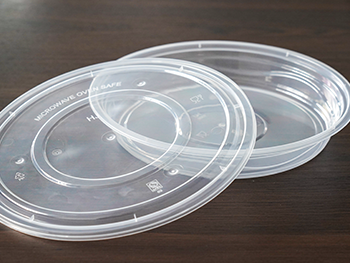
Clear Thickened Disposable Plastic 1250 Round Basin: A Comprehensive Industry Guide
Introduction
The clear thickened disposable plastic 1250 round basin represents a specific category of food-service and utility packaging designed for high-capacity, single-use applications where product visibility and structural integrity are paramount. Unlike standard thin-walled disposable containers, the "thickened" designation indicates a deliberate engineering choice to enhance durability, load-bearing capacity, and resistance to deformation during transport and handling. The "1250" specification typically refers to a nominal capacity of 1250 milliliters, positioning this basin size between individual serving bowls and larger catering basins.
This guide provides an industry-neutral overview of the clear thickened disposable plastic 1250 round basin, covering its material composition, design features, performance advantages, typical specifications, and application scenarios. The information is intended for procurement professionals, packaging designers, and food-service operators seeking a factual understanding of this product category without reference to specific manufacturers or brands.
Definition and Material Composition
A clear thickened disposable plastic 1250 round basin is a single-use, open-top circular container manufactured primarily from thermoplastic polymers. The defining characteristics are its transparency, its wall thickness (which exceeds that of conventional disposable bowls), and its nominal capacity of approximately 1250 milliliters.
The dominant material used in the production of these basins is food-grade polypropylene (PP). Polypropylene is selected for this application due to its favorable balance of properties: it is lightweight, possesses good chemical resistance, and can be formulated to achieve high transparency through the use of clarifying agents or random copolymer structures . Food-grade PP intended for direct food contact must comply with relevant regulatory standards, including FDA requirements in the United States and equivalent frameworks in other jurisdictions. The material must be free from contaminants and suitable for contact with aqueous, acidic, and fatty food types under normal conditions of use.
Transparency in PP is achieved through controlled crystallization during the cooling phase of the injection molding process. Clarifying additives increase the rate of crystallization and reduce the size of spherulites (crystalline structures) below the wavelength of visible light, allowing light to pass through rather than scatter . This results in the characteristic "clear" appearance that distinguishes these basins from opaque or natural-colored alternatives.
The "thickened" attribute refers to a higher gram weight per unit area compared to standard disposable basins. While a conventional thin-wall bowl might have a wall thickness in the range of 0.3 to 0.5 millimeters, thickened basins typically exhibit wall thicknesses that provide greater rigidity and resistance to flexing under load. This is achieved through mold design and processing parameters rather than a simple increase in material density.
Key Advantages of Clear Thickened Disposable 1250 Round Basins
The combination of clarity, capacity, and structural reinforcement yields several functional advantages that explain the prevalence of this format in food service and retail environments.
Enhanced Product Visibility. The transparent construction allows for immediate visual inspection of contents without opening or disturbing the packaging. In takeaway and delivery contexts, this transparency serves as a quality assurance mechanism: customers can verify the condition and quantity of food before consumption, which builds trust and reduces complaints. For retail applications involving bulk foods, grains, or prepared salads, clarity enables rapid inventory assessment and attractive product presentation. The visual appeal of layered ingredients—such as a salad with distinct strata of vegetables, proteins, and dressings—is preserved and enhanced by the clear basin walls .
Structural Rigidity and Load Bearing. The thickened wall design directly addresses the primary weakness of standard disposable basins: insufficient rigidity under load. A 1250-milliliter basin filled with a dense food product (such as soup, stew, or marinated items) can weigh in excess of 1.3 kilograms. Thin-walled containers may flex, buckle, or crack when lifted, especially if the user grips only one side. Thickened basins distribute stress more effectively across the base and walls, resisting deformation and reducing the risk of catastrophic failure during handling. This rigidity also facilitates stacking: filled and lidded basins can be stacked vertically without the lower units collapsing under the weight of those above, optimizing storage and transport efficiency .
Thermal Tolerance. Food-grade PP basins are engineered to withstand a range of temperatures relevant to food service. Typical specifications indicate tolerance from approximately -20°C to 120°C, enabling the same basin to be used for freezing, refrigeration, and microwave reheating . This versatility simplifies inventory management, as a single SKU can serve cold, ambient, and hot applications. It should be noted, however, that while PP is microwave-safe, the lid material (often a different polymer or a PP lid with a sealing gasket) may have different thermal limits and should be evaluated separately.
Leak Resistance and Seal Integrity. When paired with a compatible lid, clear thickened round basins can achieve reliable leak-resistant seals. The circular geometry is advantageous here: unlike square or rectangular containers, which have corners where sealing pressure may be uneven, a round rim allows for uniform gasket compression around the entire circumference. This reduces the likelihood of leakage during transport, particularly for liquid or semi-liquid contents. The thickened rim also provides a more substantial surface for the lid to grip, improving retention compared to thinner-walled alternatives .
Nesting and Space Efficiency. Empty basins are designed to nest within one another, allowing for compact storage and reduced shipping volume. The degree of nesting is a function of the wall taper angle: a more pronounced taper allows deeper nesting but may reduce the internal volume for a given external footprint. Thickened basins typically employ a moderate taper that balances nesting efficiency with usable capacity and stacking stability when filled.
Typical Specifications and Dimensional Considerations
While specific dimensions vary by mold design and intended application, the following parameters represent common industry norms for clear thickened disposable 1250 round basins. These figures are provided for general reference and should not be treated as fixed standards.
Nominal Capacity. The 1250 designation indicates a nominal volume of 1250 milliliters, equivalent to 1.25 liters or approximately 42 fluid ounces. It is important to distinguish between nominal capacity (the volume the basin is designed to hold, often measured to the brim) and usable capacity (the volume that can be filled without risk of spillage during handling or transport). Usable capacity is typically 80 to 90 percent of nominal capacity, yielding approximately 1000 to 1125 milliliters of practical fill volume.
Top Diameter. Round basins of this capacity generally feature a top outer diameter in the range of 170 to 180 millimeters. This dimension determines the footprint of the basin and compatibility with lids and carrying trays. A diameter in this range allows the basin to accommodate generous portions while remaining manageable for a single hand to carry.
Height. The height of a 1250-milliliter round basin is typically between 70 and 85 millimeters. The height-to-diameter ratio influences both stability (a lower ratio provides a lower center of gravity when filled) and visual proportions. A relatively shallow, wide profile is common for basins intended for foods that are accessed with a spoon or scoop, while slightly taller profiles may be used for liquid-heavy applications.
Wall Thickness. Thickened basins typically exhibit wall thicknesses in the range of 0.6 to 1.0 millimeters, depending on the specific mold and material formulation. The base may be marginally thicker than the sidewalls to provide additional puncture resistance and dimensional stability. Thickness distribution is a critical quality parameter: uneven wall thickness can cause warping, stress concentration, and inconsistent transparency.
Material Density and Weight. The empty weight of a clear thickened 1250 round basin is commonly between 25 and 40 grams, reflecting the material contribution required for the thickened construction. For comparison, a thin-walled 1000-milliliter bowl might weigh 12 to 18 grams. The additional material translates directly into improved rigidity and crack resistance.
Temperature Range. As noted, food-grade PP basins are typically rated for continuous service from -20°C to 120°C. Brief exposure to temperatures outside this range may be tolerated but is not recommended for repeated use. Basins intended for microwave use should be clearly labeled as such and should not be used under broiler elements or on stovetops.
Compatibility with Lids. Clear thickened round basins are typically paired with lids made from the same PP material (for microwave compatibility) or from polyethylene terephthalate (PET) for enhanced clarity in cold applications. Lid designs include flat snap-on lids, domed lids for additional headspace, and vented lids for hot foods that release steam. The rim geometry of the basin must be matched to the specific lid design to ensure a proper seal; lids are generally not interchangeable between different basin molds.
Applications and Use Cases
The clear thickened disposable 1250 round basin serves a diverse range of applications across food service, retail, and institutional settings. The common thread across these uses is the need for a container that is large enough to hold a substantial portion, transparent enough to display contents attractively, and robust enough to withstand the rigors of transport and handling.
Food Delivery and Takeaway. The most prominent application is in the takeaway and delivery sector. The 1250-milliliter capacity is well-suited to family-sized portions of soups, stews, curries, noodles, and rice dishes. The clear walls allow delivery drivers and customers to confirm the contents and check for spills without opening the lid. The thickened construction resists crushing when bags are packed tightly or when containers are stacked during transport .
Catering and Buffet Service. In catering environments, these basins serve as serving vessels for cold salads, cut fruit, condiments, and bulk side dishes. The transparency allows buffet patrons to see the offering clearly, and the sturdy construction withstands the repeated scooping and serving motions that thin-walled containers cannot endure. The basins can be nested in ice baths or placed in chafing dish frames for temperature control.
Retail Bulk Foods. Grocery stores and specialty food retailers use clear round basins for packaging bulk items such as olives, pickles, marinated vegetables, dried fruits, and nuts. The clarity enables customers to assess product quality, while the leak-resistant lid (when properly applied) contains brines and oils that would otherwise create mess and safety hazards. The 1250-milliliter size is appropriate for household quantities that are consumed over several days.
Meal Preparation and Cloud Kitchens. Commercial and home meal preparation services utilize these basins for portioning and storing ingredients. The ability to see contents at a glance improves inventory rotation and reduces waste from forgotten items. The microwave and freezer tolerance supports the full cycle from preparation through storage to reheating.
Non-Food Utility Applications. While the primary market is food service, clear thickened PP basins also find use in non-food contexts where a durable, transparent, disposable container is required. Examples include organizing small parts in workshops, holding craft supplies, and serving as temporary water or wash basins in healthcare and personal care settings. For these applications, the food-grade certification is not essential, but the structural and visual properties remain advantageous.
Quality Considerations and Selection Criteria
When evaluating clear thickened disposable 1250 round basins, several quality attributes should be assessed to ensure fitness for purpose.
Optical Clarity. High-quality basins exhibit uniform transparency with minimal haze or visible flow lines. Haze, measured as the percentage of light scattered rather than transmitted directly, should be low—typically below 10 percent and ideally below 5 percent for premium applications . Flow lines or weld lines (visible marks where material streams converge during molding) indicate suboptimal processing conditions and may correspond to weak points in the wall.
Dimensional Consistency. The top diameter, height, and rim profile should be consistent from unit to unit to ensure reliable lid fit and stable stacking. Variations in rim diameter can cause lids to fit loosely on some basins and tightly on others, leading to leaks or application difficulties.
Impact Resistance. The thickened walls should provide adequate resistance to cracking when the basin is dropped or struck. A simple field test involves filling a basin with water and allowing it to fall from a moderate height onto a hard surface; while not a standardized laboratory test, this can reveal gross deficiencies in material toughness or molding quality.
Chemical Resistance. Basins intended for contact with acidic foods (tomato-based sauces, citrus marinades) or fatty foods should be verified for compatibility. PP generally offers good resistance to these food types, but low-quality material or improper processing can compromise performance.
Regulatory Compliance. For food-contact applications, documentation confirming compliance with relevant regulations (FDA 21 CFR, EU 10/2011, or equivalent) should be obtained from the supplier. This includes declarations of compliance for the base polymer, any additives (such as clarifying agents), and colorants if applicable.
Environmental Considerations
The disposable nature of these basins raises legitimate environmental concerns. Clear thickened PP basins are technically recyclable through standard plastic recycling streams (resin identification code 5 for polypropylene). However, in practice, recycling rates for food-contact packaging are constrained by contamination (food residue must be removed before recycling) and by the limited availability of collection infrastructure in many regions.
Some manufacturers offer basins produced with a proportion of post-consumer recycled (PCR) content, although food-contact regulations may restrict the use of PCR in direct food applications depending on jurisdiction. Biodegradable alternatives, such as basins made from polylactic acid (PLA) or polyhydroxyalkanoates (PHA), exist but generally do not match the combination of clarity, thermal tolerance, and cost-effectiveness of PP. Operators should weigh functional requirements against sustainability goals and local waste management capabilities when selecting materials.
Conclusion
The clear thickened disposable plastic 1250 round basin is a mature, well-characterized product category that addresses a specific set of functional needs: high capacity, visual accessibility, structural durability, and thermal versatility. Its material foundation in food-grade polypropylene, combined with mold designs that prioritize wall thickness and rim integrity, makes it suitable for demanding food-service applications ranging from delivery and catering to retail bulk packaging.
Procurement decisions should consider optical quality, dimensional consistency, impact resistance, and regulatory compliance alongside unit cost. As with any packaging format, the environmental implications of single-use plastics warrant attention, and operators are encouraged to explore recycling pathways and material innovations where feasible. For applications where clarity, capacity, and strength are non-negotiable, the clear thickened 1250 round basin remains a practical and reliable choice.

This website uses cookies to ensure you get the best experience on our website.

 Español
 Pусский
 العربية
 Tiếng Việt

 WhatsApp
 Phone
 E-mail
 Message