
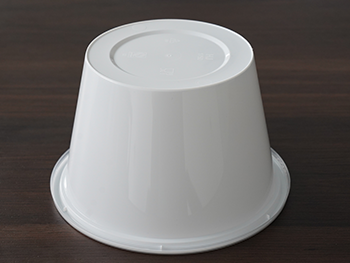
The white thickened disposable plastic 1750 round bucket ranks among the most widely adopted large-capacity containers across foodservice, catering, takeaway and packaging sectors. Boasting a usable volume of 1750 ml (1.75 L) paired with thickened, rigid wall construction, this round disposable bucket delivers the structural robustness of reusable pails at the low cost and convenience of single-use packaging. For restaurants, cloud kitchens, caterers, bakeries, event planners and food manufacturers, this product solves a persistent operational challenge: transporting, storing and serving bulk food items including soups, sauces, salads, desserts and semi-liquid products without leakage or cracking, while cutting down on labor and hygiene costs associated with washing reusable containers.
This guide serves as a neutral, full-spectrum industry overview of the white thickened disposable plastic 1750 round bucket. It covers product definition, raw materials, manufacturing techniques, standard specifications, functional benefits of thickened design, mainstream applications, food safety requirements, sustainability considerations, procurement guidelines and FAQs. Whether you are a procurement manager sourcing bulk disposable plastic buckets, a restaurant owner selecting takeaway packaging, or a content creator developing industry reference pages, this content will help you assess and understand this product category objectively.
A white thickened disposable plastic 1750 round bucket is a single-use round container with a nominal capacity of 1750 milliliters. It is injection molded from food-grade polypropylene (PP), featuring walls noticeably thicker and sturdier than conventional thin-wall disposable bowls.
The term white refers to its opaque bright-white resin. This finish delivers a clean, premium look while masking the color of food contents. Thickened differentiates it from ordinary thin-gauge disposable tableware: extra material and reinforced structural geometry are applied to side walls, base and rim to create a rigid, load-bearing body that resists bending, denting and cracking during normal handling.
The 1750 marking represents its nominal liquid capacity of 1750 ml, equivalent to roughly 1.75 liters or 59.2 fl oz. This size fits family-style servings, bulk catering portions and large-format packaging that standard 500 ml, 750 ml and 1000 ml containers cannot accommodate. The bucket tapers outward from base to top; its actual usable fill volume is slightly lower than the brim capacity. Purchasers must always check manufacturers’ published fill-line / usable capacity data.
This product belongs to the disposable plastic food container family yet stands out in three aspects: round bucket/pail silhouette (instead of square or rectangular boxes), large single-unit capacity and heavy-duty thickened construction. It is normally paired with matching snap-on or plug-in lids to form sealed, leak-resistant packaging for transit. In trade listings, it may also be named: 1750 ml round plastic bucket, 1750 ml disposable pail, thickened PP round bucket, jumbo disposable bucket, large round food container — all referring to the same product category.
The primary raw material for white thickened disposable plastic 1750 round buckets is polypropylene (PP), a thermoplastic polymer marked with resin identification code 5 (triangle number 5 symbol). PP is preferred for this application for multiple reasons: food-safe when produced to food-contact standards, BPA-free in standard formulations, and balances stiffness, impact resistance and heat resistance better than common commodity plastics like PE or PS.
PP features a wide working temperature range. Food-grade PP containers typically withstand temperatures from -20 °C to 120 °C (-4 °F to 248 °F). It works for cold items such as chilled salads, frozen desserts and refrigerated sauces, as well as hot food including freshly cooked soup, curry, porridge and hot side dishes. Most food-grade PP buckets support short microwave reheating cycles. However, end users must strictly follow manufacturers’ temperature and microwave instructions; lids (PP or PET) should be removed or vented before heating.
The opaque white appearance comes from titanium dioxide (TiO₂) pigment blended into PP resin during compounding. This brings multiple practical advantages: opaque walls hide food contents, suiting operators who prefer concealed meals and consistent clean presentation across menu lines. The white surface creates high contrast for printed logos, labels and handling prompts, and the bright interior visually reinforces hygiene perception for food presentation.
White thickened disposable plastic 1750 round buckets are almost exclusively manufactured via injection molding. Molten PP is injected under high pressure into precision steel molds shaped as bucket cavities, then cooled and ejected. Injection molding enables precise control over wall thickness, rim contour, stacking lugs and reinforcing ribs. This is how thickened buckets achieve far higher material weight than thin-wall thermoformed bowls of equal capacity.
Heavy-duty 1750 ml buckets normally weigh 28–40 grams, subject to mold design and reinforcement level. By comparison, thin-wall disposable bowls of similar volume may weigh half or less. Extra material is strategically distributed: thickened rim prevents crushing during lid snapping; reinforced side walls avoid bulging under internal pressure and handling stress; strengthened base bears food weight without sagging. Many models add external ribs, stepped side profiles or textured grip bands to boost rigidity without excessive material consumption.
Since white thickened disposable plastic 1750 round buckets use proprietary molds across different manufacturers, dimensions vary by supplier. Below are typical industry parameters for reference only:
Nominal capacity: 1750 ml (≈1.75 L / 59 fl oz), measured to brim; usable fill capacity is generally slightly less
Top / rim diameter: approx. 17 cm (6.7 in)
Bottom / base diameter: approx. 12 cm (4.7 in), tapered nesting design
Height: approx. 11.5 cm (4.5 in)
Wall: thickened rigid food-grade PP; heavy-duty version weight: 28–40 g per piece
Material: food-grade polypropylene, BPA-free, resin code 5
Temperature resistance: bucket body -20 °C ~ 120 °C, subject to material grade and manufacturer specs
Shape: round, tapered top-to-base, nestable and stackable
Lid: sold separately; snap-on PP lid or transparent PET flat lid; sealing performance depends on lid design
Color: opaque white standard; custom colors available for bulk orders
Surface: smooth interior for easy food release and simple cleanup; exterior may include reinforcing ribs or textured grip zone
Buyers need to obtain the manufacturer’s TDS (technical data sheet) and dimension drawings before bulk procurement. Exact dimensions, wall thickness, gram weight, stacking height and temperature rating determine compatibility with existing lids, racks and filling equipment. A 1750 ml bucket from one factory may not fit lids produced by another supplier even with identical nominal capacity.
Thickened wall construction is the core differentiator of this product. Understanding its value helps buyers select suitable grades for their scenarios.
Improved crack & break resistanceThin disposable containers easily crack at rims, split at bases or bend dangerously when filled with heavy, hot or liquid food. Thickened 1750 round buckets are engineered for rigorous handling: users can carry by the rim with one hand, place into delivery bags, stack multiple units or drop onto countertops without rupture. This reliability cuts product loss, customer complaints and spill cleanup expenses.
Pressure-resistant leak-proof performanceWhen matched with compatible lids, rigid rims maintain consistent sealing surfaces, preventing lid pop-off or seal relaxation during transit. This is critical for soups, curries, gravies, sauces and marinades — liquids that seep through gaps in low-grade containers.
Enhanced stacking capabilityThickened buckets are designed for dual stacking modes: empty buckets nest tightly together to save storage and shipping space; lidded filled buckets can be stacked 2–3 layers on racks or inside refrigerators. Thickened rims and bases disperse load weight to avoid collapse, delivering major efficiency gains for caterers preparing mass food batches.
Better thermal retentionThicker walls offer superior insulation compared to thin alternatives, retaining heat for hot food and coldness for chilled products over short delivery windows. While plastic buckets are not thermal vacuum flasks, extra material noticeably slows heat transfer versus thin bowls of identical capacity.
Premium perceived qualityFor restaurants and high-end food brands, solid weight and rigidity convey durability and quality. A flexible bucket feels cheap, while firm heavy packaging builds trust. This psychological factor improves customer satisfaction, especially for premium takeaway, ghost kitchen delivery and event catering where packaging forms part of brand experience.
Eight core practical strengths define this product category:
Large single-unit capacityAt 1750 ml, it accommodates portions beyond small disposable containers, reducing packaging quantity per order and simplifying portion control for family meals, shared platters and bulk dishes.
High rigidity & durabilityThickened structure resists cracking, denting and collapse, protecting contents during filling, stacking, transport and customer handling.
Leak-resistant with fitted lidsWhen paired with matching snap-on or plug-in lids, it forms reliable sealing for liquid and semi-liquid food, minimizing spillage inside delivery bags and vehicles.
Wide temperature adaptabilityRated approximately -20 °C to 120 °C, suitable for hot takeaway meals, chilled desserts, freezer storage and short microwave reheating (per manufacturer approval).
Food-safe raw materialFood-grade BPA-free PP features stable chemical properties. It does not leach odor or flavor into food under normal usage and meets food authority requirements when complete compliance documents are provided.
Shatterproof & logistics-friendlyUnlike glass or ceramic, PP will not break during transport. Empty buckets are lightweight and nestable, cutting per-unit freight cost and supply chain breakage losses.
Hygiene & labor cost reductionSingle-use design eliminates washing, sanitizing and cross-contamination risks between reuse cycles — a major cost and compliance benefit for high-output kitchens.
Flexible presentation & brandingOpaque white bodies act as clean blank substrates for labels, stickers or printed sleeves. Uniform round shape stacks neatly on shelves, refrigerators and service counters.
Compared with reusable pails, disposable buckets remove return logistics, cleaning overhead and asset inventory management of costly containers. Compared with thin disposables, they deliver sufficient strength for heavy, hot and liquid food. Compared with square boxes, round buckets work better for soups, sauces and spoonable meals, and tapered profiles enable tight nesting during storage.
The primary use case is large-format takeaway and delivery packaging. Cloud kitchens, fast casual restaurants and traditional dining establishments use it for soups, stews, curries, hot pot, rice/noodle bowls and family main courses. The 1750 ml size is widely used for family combos and sharing platters, packing a full meal in one sealed bucket to reduce packaging quantity and labor.
Caterers serving weddings, corporate banquets and large gatherings rely on large disposable buckets to transport bulk dishes from central kitchens to venues. The buckets perform well inside insulated carriers and stack on service racks for portioning at buffet stations. Thickened construction withstands loading, vehicle transit and on-site handling far better than thin disposable alternatives.
For liquid and semi-liquid foods (broths, sauces, gravies, marinades, dressings and condiments), sealed 1750 ml buckets provide stable packaging. Tall side walls reduce splashing during filling; rigid rims guarantee proper lid seating. Food manufacturers and central kitchens also adopt these buckets as intermediate bulk packaging for sauces for subsequent repackaging.
Bakeries and dessert makers use white buckets for whole cakes, cake cuts, puddings, mousse, custard, ice cream and frozen desserts. Opaque white material shields products from light damage; stackable design enables efficient refrigeration and freezer storage. The 1750 ml capacity fits takeaway whole cakes and bulk dessert supplies supplied to cafes and restaurants.
Supermarkets, delis and salad bars deploy lidded buckets for prepared salads, coleslaw, pasta salad, fresh cut fruits and chilled side dishes. Packaging protects food against contamination and dehydration. Clear lid variants allow shoppers to view contents while the white base maintains tidy retail display.
Beyond foodservice retail, 1750 ml round buckets function as packaging and handling containers in food production lines for pre-blended ingredients, batter, fillings and semi-finished goods moving between production stages. The same heavy-duty buckets can also hold paint, adhesives, hardware and agricultural supplies in non-food scenarios. Only food-grade versions can contact food.
Commercial procurement needs to check multiple criteria beyond nominal capacity:
Confirm usable capacity and dimensions. Request technical drawings and verify top diameter, base diameter, height and fill-line capacity against portion sizes, lids and storage racks.
Validate material grade and certifications. Buckets shall be virgin or food-grade PP with compliance certificates such as FDA food contact certification, EU Regulation 10/2011 or equivalent national standards, and BPA-free formulation.
Check gram weight and wall thickness. Higher gram weight generally means stronger buckets but increases material and shipping expense. Match grade to scenarios: 28–30 g buckets fit salads; heavy soup and catering applications require 34–40 g heavy-duty buckets.
Evaluate lid compatibility and sealing performance. Leakage protection depends on lids. Test snap / plug fit with the actual lids you plan to purchase; check sealing performance for liquid food and venting design if microwave reheating is required.
Assess nesting and stacking performance. Confirm empty buckets nest compactly for storage; lidded filled buckets stack safely inside racks and refrigerators.
Review temperature ratings and microwave instructions. For hot food serving or microwave reheating, confirm official temperature range and microwave usage guidance from suppliers.
Address custom requirements. White is standard, but most manufacturers support custom colors, direct printing, lids with cutlery slots and special rim profiles subject to minimum order quantities.
Food safety compliance is the top priority for disposable food containers, including white thickened disposable plastic 1750 round buckets.
Food-grade PP is a thoroughly tested polymer with a long track record of safe food contact. Under normal use conditions, it contains no BPA (not used in PP production), no phthalates in standard resin formulations and will not transfer odors or flavors to food. Regulatory frameworks including US FDA 21 CFR food contact rules and EU Regulation (EC) No 1935/2004 (plastic specific rules under EU 10/2011) set migration limits for substances that may transfer from plastic packaging into food. Qualified products use resins and additives complying with these migration thresholds.
Practical operational checklist: source buckets from suppliers who can supply food-grade certificates and compliance paperwork; store buckets and lids in clean dry areas away from heat and contaminants; do not reuse single-use buckets beyond rated temperature and usage duration; follow manufacturer microwave guidance (normally remove or vent lids). Plastic buckets cannot withstand hot oil, prolonged high heat, oven or open flame exposure.
Disposable plastic packaging faces growing environmental scrutiny, so responsible purchasers assess the full lifecycle of 1750 ml round buckets.
PP is among the most recyclable plastics where waste collection infrastructure exists, marked with resin code 5. Many municipal recycling programs accept PP containers. Clean empty buckets qualify for post-consumer recycling, while factory production scrap is routinely reground and recycled. Some manufacturers offer buckets blended with recycled PP. However, recycled material for direct food contact is strictly regulated and restricted or prohibited in many regions.
Weight is another sustainability factor. Thickened buckets consume more raw material than thin containers, raising unit cost and environmental footprint. Nevertheless, robust packaging prevents food loss caused by breakage and spillage — food waste reduction is widely recognized as the dominant environmental factor in packaging decisions. A reliable heavy-duty package may deliver better overall sustainability than lightweight packaging prone to failure.
For operators aiming to cut environmental impact: select the lightest thickened grade that still meets performance requirements; order bulk packs to minimize shipping weight; cooperate with suppliers providing material sourcing and recycling guidance. Clear resin code printing on buckets or outer packaging helps end users recycle correctly.
Maximize service life and performance of white thickened disposable plastic 1750 round buckets with these operational guidelines:
Store buckets and lids in clean, dry spaces, off the floor, away from direct sunlight and intense heat to preserve appearance and physical properties.
Keep buckets and lids from the same production batch together, as minor mold discrepancies may affect lid fit.
Leave adequate headspace when filling hot liquids to avoid overflow and pressure buildup during lid closure.
Remove or vent lids for microwave reheating unless the supplier certifies full bucket-lid assembly as microwave-safe.
Do not place plastic buckets in conventional ovens, stovetops, broilers or contact hot oil exceeding rated temperature limits.
Dispose of used buckets per local recycling regulations; rinse and empty buckets before recycling if local rules require pre-cleaning.
It refers to the nominal capacity in milliliters: 1750 ml, about 1.75 liters. Brim capacity varies slightly between manufacturers, and usable fill volume is usually lower. Always refer to specification sheets.
Yes, when injection molded from food-grade polypropylene to official standards. Select BPA-free PP with compliance documents such as FDA 21 CFR or EU Regulation 10/2011.
Generally yes. Food-grade PP buckets are rated approximately -20 °C to 120 °C, suitable for freshly cooked soups, stews, curries and hot side dishes. Confirm manufacturer temperature ratings before use.
Most PP buckets support short microwave reheating within rated temperature range, but lids usually need removal or venting. Always check supplier instructions, since lid materials differ.
Designed as single-use packaging. A clean food-grade PP bucket may be reused for cold storage in non-commercial scenarios after thorough cleaning. Reuse is not the intended design; contact with hot oil, fatty food or abrasives accelerates degradation. Foodservice operations should follow single-use hygiene standards.
Lidded thickened 1750 ml buckets achieve leak resistance for liquid and semi-liquid food with properly fitted lids. No injection-molded container is leak-proof under extreme misuse. Always test bucket-lid combinations with your food products and delivery conditions.
Typical heavy-duty 1750 ml buckets weigh 28–40 grams, varying with wall design, reinforcement and mold configuration. Gram weight is a useful reference for strength, yet wall distribution and structural ribs matter equally.
Yes. Empty buckets nest inward for compact storage; lidded filled buckets can be stacked on racks and refrigerators. Thickened rims and bases support stacking loads without collapse.
White is standard. Most manufacturers offer custom colors, printed sleeves/labels and specialized rim or lid features for bulk orders.
Thickened buckets use more raw material, reinforced rims and upgraded wall geometry. They feature higher strength, better leak resistance when sealed, superior stacking performance and stronger heat retention versus thin-wall bowls of similar capacity. Unit cost is higher, but performance is ideal for heavy, hot, liquid and large-volume servings.
The white thickened disposable plastic 1750 round bucket fills a distinct, valuable niche in the packaging industry. It delivers large capacity for family meals, bulk catering, soups, sauces and desserts with mechanical strength unattainable by thin disposable containers. Made of food-grade BPA-free polypropylene with reinforced thick walls, paired with matching lids it provides leak-resistant sealing, safe handling for hot and cold food, efficient nesting and stacking, and stable performance across takeaway, catering, retail and food manufacturing.
For buyers, core evaluation criteria remain consistent across suppliers: verify real usable capacity and dimensions, confirm food-contact material compliance, match gram weight and wall design to use cases, test lid sealing performance, and align temperature / microwave ratings with menu items. When properly selected, the 1750 ml thickened round bucket is a reliable, cost-effective packaging workhorse that reduces breakage, spillage and labor while protecting food quality for end customers.

This website uses cookies to ensure you get the best experience on our website.

 Español
 Pусский
 العربية
 Tiếng Việt

 WhatsApp
 Phone
 E-mail
 Message