
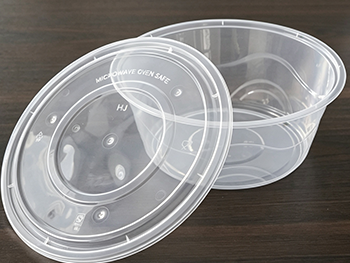
Clear Thickened Disposable Plastic 3500 Round Basin: Industry Guide and Product Overview
The clear thickened disposable plastic 3500 round basin occupies a practical middle ground in the disposable food packaging market, bridging the gap between standard single-serving bowls and larger bulk catering basins. Defined by its nominal 3500ml capacity, round geometry, transparent construction, and reinforced wall sections, this basin format serves operations that need substantial volume without the extreme footprint of the 4000ml or 4800ml classes.
The “clear” designation refers to the transparency of the polypropylene material, enabling visual content identification without lid removal. The “thickened” attribute indicates a deliberate manufacturing choice to increase wall section and base rigidity beyond standard disposable ware, enhancing load-bearing capacity and resistance to deformation during transport. Together, these characteristics make the 3500ml round basin a practical solution for family-sized portions, bulk ingredient handling, and prepared food display where both volume and visibility matter.
This guide provides a specification-oriented overview of the product category, covering material composition, design advantages, typical technical parameters, and primary industry applications. It is intended for procurement professionals, packaging specifiers, and food service operators seeking factual industry information rather than brand-specific recommendations.
The vast majority of clear thickened disposable round basins in the 3500ml class are manufactured from food-grade polypropylene (PP). Polypropylene is a thermoplastic polymer valued in food contact applications for its chemical inertness, resistance to fats and oils, and favorable thermal stability . Food-grade PP used in basin manufacturing typically complies with regulatory frameworks governing food contact substances in major markets.
The thermal properties of PP are central to the product’s utility. Standard PP basins are engineered to withstand service temperatures ranging from approximately -20°C to 120°C . This range accommodates freezer storage for preservation and microwave reheating for service, two workflows frequently combined in modern food delivery and meal preparation operations. The thickened grade provides an additional margin against localized warping when reheating dense, high-fat foods.
Clear thickened round basins are predominantly produced through injection molding, a process that forces molten polymer into a precision-machined steel mold under high pressure . Injection molding is preferred over thermoforming for thickened products because it yields more uniform wall thickness and superior dimensional consistency across high-volume production runs.
The mold design for a round basin incorporates a draft angle on the vertical walls to facilitate ejection and nesting, while the base is typically reinforced with a slight concave curvature or radial ribbing to distribute compressive loads. The “thickened” attribute is achieved through mold cavity dimensions that specify a greater wall section than standard disposable containers, resulting in a basin that resists the “oil-canning” effect—the audible popping and permanent deformation that occurs when thin-walled containers are subjected to stacking loads or lateral compression .
The transparency of the clear basin provides a practical advantage that is often underestimated in procurement decisions. In high-volume food production and delivery operations, the ability to visually confirm fill levels, identify contents, and inspect for foreign objects without breaching the seal accelerates quality control and order accuracy. For takeout and delivery applications, the clear snap-on lid allows customers and delivery personnel to identify contents without opening the container .
From a storage and logistics standpoint, clear basins permit warehouse staff to verify stock without opening master cartons, reducing contamination risks and handling time.
The 3500ml capacity imposes specific demands on the lid-to-base interface. A filled 3500ml basin can weigh several kilograms, and movement during transport introduces dynamic forces that can compromise a poorly designed seal. Thickened basins address this through a more rigid rim geometry that resists flexing when the lid is applied.
Round basins possess a structural advantage over square or rectangular containers in seal integrity: the continuous full-circle sealing design eliminates the corner gaps that are common failure points for liquid leakage . Matching lids are typically manufactured from a slightly more flexible PP grade, allowing the lid skirt to snap over the basin rim with an interference fit.
The round shape and tapered wall design allow empty basins to nest deeply, reducing storage volume in warehouses and delivery vehicles. When filled and lidded, the flat lid surface and reinforced base create a stable stacking interface. The thickened walls contribute to stack stability by resisting the lateral deformation that can cause a stack to lean or collapse under its own weight . For caterers and central kitchens, this stackability translates directly into reduced storage footprint and more efficient use of refrigerated space.
The following parameters represent the typical range of specifications found in the commercial market for clear thickened disposable 3500 round basins. Individual products may vary, and procurement decisions should always be based on the manufacturer’s published datasheet.
Capacity and Dimensions. The nominal capacity is 3500ml. Industry-reported dimensions for this basin class typically include an outer diameter of approximately 240mm and a height of approximately 103mm . Dimensional tolerances for injection-molded basins of this size are typically maintained within ±1mm on critical dimensions, with weight tolerances of ±5% .
Material and Construction. The basin body is food-grade polypropylene. The thickened specification indicates a wall section greater than standard disposable basins of equivalent capacity. The basin is described as pressure-resistant, flexible, and resistant to cracking or deformation under extrusion . Lids are supplied separately or as part of a set and are generally lighter than the base.
Thermal Performance. The service temperature range is typically stated as -20°C to 120°C, permitting freezer storage and microwave reheating . These ratings apply to the material in its as-molded state; repeated thermal cycling or prolonged exposure to fats at the upper end of the range may reduce effective service life, particularly at the lid seal.
Color and Customization. While the defining characteristic of this category is clarity, base material may be supplied in transparent, translucent white, or black variants, with clear being the specification most closely associated with the “clear thickened” designation . Custom color matching and branded printing on lids or basin walls are available from most manufacturers, subject to minimum order quantities.
The 3500ml round basin is widely used in the takeout and delivery segment for family-sized portions of soups, stews, noodles, rice dishes, and shared appetizers. Its capacity aligns with group orders where a single container serves multiple individuals. The clear construction allows delivery personnel and customers to confirm contents visually, while the thickened walls prevent the buckling that can occur when a heavy, liquid-filled basin is placed in an insulated delivery bag and subjected to jostling .
In commissary kitchens and institutional meal programs, the 3500ml basin functions as a bulk preparation and storage vessel. It is used for portioning ingredients, marinating proteins, and holding prepared components before final assembly. The transparency facilitates FIFO (first-in, first-out) inventory rotation, and the PP material’s chemical resistance accommodates acidic marinades and oil-based dressings without degradation. The basin can be lidded and stacked in walk-in refrigerators, maximizing vertical space utilization.
Supermarket deli counters and prepared food sections utilize clear 3500ml basins for displaying and dispensing bulk salads, olives, marinated vegetables, and cold pasta dishes. The visibility of the product through the packaging serves a merchandising function, allowing customers to assess product quality and freshness. The thickened construction supports the weight of dense, wet foods without sagging or distorting on the shelf.
While the primary market is food service, the clear thickened round basin also finds use in non-food contexts where disposable, large-volume containment is required. These include laboratory and clinical settings for temporary holding of solutions or organization of supplies, as well as light industrial applications for sorting small components. In these contexts, the basin’s cleanliness, chemical inertness, and dimensional consistency are the primary selection criteria.
The term “thickened” is not a standardized numerical specification but rather a relative descriptor. Procurement professionals should request quantitative data from suppliers—specifically, the nominal wall thickness in millimeters at the sidewall and base, and the unit weight in grams. A basin advertised as thickened but with a unit weight significantly below the industry average for its capacity may not deliver the expected durability. The relationship between weight and performance is not linear, however; design factors such as rib placement and polymer grade also influence rigidity.
The lid is the most common point of failure for liquid-filled basins. Buyers should confirm that lids are supplied from the same manufacturer and are designed specifically for the basin in question; interchanging components from different suppliers rarely produces a reliable seal. For critical applications involving liquids, a simple in-house test—filling the basin with water, applying the lid, and subjecting it to a brief shaking or inversion cycle—can reveal deficiencies before a large order is committed.
For food contact applications, the supplier should be able to provide a declaration of compliance or a food contact statement confirming that the PP material meets the relevant regulatory requirements for the destination market. This documentation is distinct from general quality certifications and should be requested explicitly. For markets with extended producer responsibility (EPR) regulations or single-use plastic restrictions, buyers should verify the current regulatory status of PP disposable basins in their jurisdiction, as these rules are evolving in many regions.
Polypropylene is technically recyclable, designated by resin identification code 5. However, the practical recyclability of a food-contaminated disposable basin depends entirely on local collection infrastructure and the willingness of recyclers to accept post-consumer food packaging. In many jurisdictions, basins contaminated with food residue are directed to landfill or energy recovery rather than mechanical recycling.
The thickened format, while offering functional benefits, uses more material per unit than thin-walled alternatives, which is a relevant consideration for organizations with material reduction targets. Some manufacturers offer basins incorporating post-consumer recycled (PCR) polypropylene, though food contact applications for PCR content are subject to regulatory approval that varies by jurisdiction. For procurement teams with sustainability mandates, the most impactful levers are typically source reduction (selecting the minimum adequate capacity and thickness), ensuring that basins are emptied and cleaned before disposal, and specifying clear labeling that aids consumers in sorting the material correctly where recycling streams exist.
The clear thickened disposable plastic 3500 round basin is a well-characterized product category serving the intersection of high-capacity food packaging and visual inventory management. Its defining attributes—polypropylene construction, approximately 3500ml nominal capacity, round geometry, transparency, and reinforced wall sections—are the result of deliberate engineering trade-offs that prioritize structural reliability and content visibility . For buyers, the critical variables are unit weight as a proxy for thickness, lid compatibility, and the availability of food contact documentation. As with any packaging decision, the optimal specification depends on the specific demands of the filling, transport, and end-use environment, and should be validated through direct testing rather than reliance on general descriptive terms alone.

This website uses cookies to ensure you get the best experience on our website.

 Español
 Pусский
 العربية
 Tiếng Việt

 WhatsApp
 Phone
 E-mail
 Message